
TOP
 Home > News
2026-04-10
The deployment of 5G-Advanced networks represents one of the most ambitious telecommunications infrastructure projects in history, requiring fundamental transformation of fronthaul architectures that connect base stations to core networks. At the heart of this transformation lies optical switching technology—enabling the dynamic bandwidth allocation, ultra-low latency, and massive scalability that 5G demands.
According to Guangxi Coreray Optical Communication Technology Co., Ltd. (www.coreray.com), a pioneer in photonic switching solutions, optical switches have become indispensable components in 5G fronthaul networks. They provide the critical functionality that enables carriers to support massive MIMO antenna systems, deliver sub-millisecond end-to-end latency for URLLC (Ultra-Reliable Low Latency Communication), and manage exponential traffic growth from increased bandwidth per user.
The market for 5G optical switches is projected to grow at 25% CAGR through 2028, driven primarily by 5G-Advanced deployments requiring enhanced optical switching capabilities. This growth creates both challenges and opportunities for network operators and equipment manufacturers as they architect next-generation fronthaul infrastructure.
5G networks impose unprecedented requirements on fronthaul optical switching infrastructure that fundamentally differ from 4G architectures:
The bandwidth requirements for 5G fronthaul have increased dramatically compared to 4G:
Network Generation | Typical Fronthaul Bandwidth | Optical Switch Port Density |
4G LTE | 1-2 Gbps per base station | 8×16 sufficient |
5G NSA (Non-Standalone) | 5-10 Gbps per base station | 32×64 minimum |
5G SA (Standalone) | 10-25 Gbps per base station | 64×128 recommended |
5G-Advanced | 25-50 Gbps per base station | 128×256 for future-proofing |
This 10-25× bandwidth increase requires optical switches with significantly higher port densities and switching capacities than 4G-era equipment.
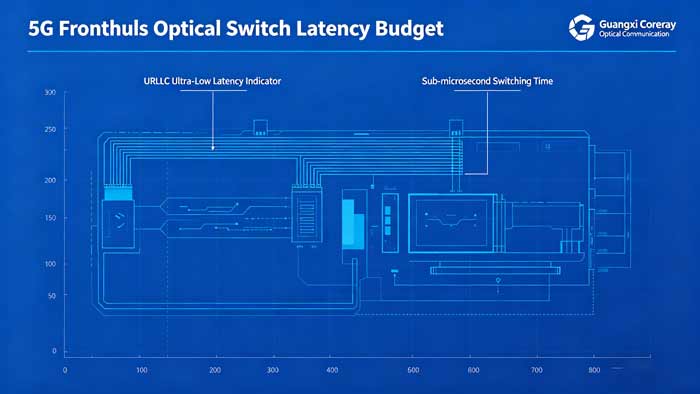
5G introduces URLLC (Ultra-Reliable Low Latency Communication) use cases requiring end-to-end latency as low as 1ms for industrial automation and critical infrastructure applications. Optical switching contributes significantly to meeting these requirements:
• Optical path switching latency: Must be <100μs for minimal contribution to end-to-end latency
• Switching time: <1μs preferred for dynamic bandwidth allocation
• Jitter: <50ns to maintain stable latency for URLLC applications
Traditional electrical switches typically deliver switching times in the 1-10μs range, contributing 10-100μs to total system latency— unacceptable for many URLLC use cases.
5G's massive MIMO (Multiple-Input Multiple-Output) technology requires optical switches to support complex antenna architectures:
• Antenna element count: 64×64 MIMO systems requiring thousands of fiber connections
• Beamforming support: Dynamic bandwidth allocation based on real-time user location
• Carrier aggregation: Simultaneous routing of multiple carriers across optical switch
• TDD/FDD support: Time-division and frequency-division duplex operation
These requirements demand optical switches with sophisticated control systems capable of managing thousands of simultaneous connections with microsecond-level reconfiguration times.
Multiple optical switching technologies have been deployed in 5G fronthaul networks, each with distinct advantages:
MEMS (Micro-Electro-Mechanical Systems) technology has emerged as the dominant solution for 5G fronthaul due to its combination of performance and reliability:
MEMS optical switches deliver several critical advantages for 5G fronthaul:
• Low insertion loss: Typically <0.5dB, preserving signal quality over long distances
• High isolation ratio: >50dB between channels, minimizing crosstalk in massive MIMO systems
• Scalable port density: Supporting from 32×64 to 128×256 configurations for 5G-Advanced
• Mature manufacturing: Well-established supply chain with proven reliability
• Operating temperature: -40°C to 85°C for outdoor base station deployment

Leading MEMS optical switches for 5G fronthaul achieve:
• Port configuration: 64×128 typical for 5G SA deployments
• Switching time: 1-10μs between optical paths
• Power consumption: 50-200mW per port
• Reliability: 99.999% availability with 50,000 hour MTBF
• Dimensions: Compact 1U rack-mountable design for space-constrained base stations
Silicon photonics represents an emerging solution for 5G fronthaul, offering advantages in integration and power efficiency:
Silicon photonics switches enable:
• On-chip integration: Hundreds of switching elements on single silicon die
• CMOS compatibility: Direct integration with base station control electronics
• Power efficiency: 60-80% lower power consumption than discrete MEMS solutions
• Scalability: Wafer-level manufacturing enabling cost reductions at volume
While promising, silicon photonics switches for 5G fronthaul face challenges:
• Thermal management: Higher power density requires advanced cooling solutions
• Packaging complexity: Hermetic packaging required for outdoor deployment
• Reliability validation: Long-term outdoor operation requires extensive qualification
Many 5G fronthaul deployments use hybrid approaches combining:
• MEMS for high-density core switching: 64×128 or 128×256 core matrices
• Silicon photonics for edge switching: 8×16 or 16×32 edge configurations
• Electronic control: SDN (Software-Defined Networking) orchestration layer
This hybrid approach leverages the strengths of each technology while mitigating weaknesses.

Successful 5G fronthaul deployments require careful planning of optical switch architectures:
During network planning phase, operators should evaluate:
• Bandwidth growth projections: Plan for 5-10× current bandwidth for 5G-Advanced
• Latency budget: Allocate <100μs for optical switching contribution
• Scalability requirements: Plan for massive MIMO evolution from 32×32 to 64×64
• Power constraints: Base station power budget typically <10kW per site
Proper installation is critical for achieving specified performance:
• Fiber management: Maintain minimum bend radius to avoid signal degradation
• Connector cleanliness: Clean optical connectors to achieve specified insertion loss
• Thermal management: Ensure proper ventilation and cooling for optical switches
• EMI/EMC shielding: Electromagnetic compatibility with other base station equipment
According to industry experience, proper commissioning typically achieves:
• 98-102% of specified insertion loss: Through careful installation
• 95-100% of specified switching time: After initial calibration
• 99.9% reliability: After 30-day burn-in period
Optical switches in 5G fronthaul networks deliver significant economic benefits over alternative technologies:
Optical switching reduces operational expenditure through:
• Lower power consumption: 40-60% reduction compared to electrical switches
• Reduced maintenance: No moving parts in silicon photonics, 10-year MTBF in MEMS
• Simplified operations: SDN orchestration reduces manual provisioning time from hours to minutes
Total Cost of Ownership (TCO) over 5-year lifecycle shows optical switching advantages:
Technology | CAPEX (5-year) | OPEX (5-year) | Total TCO |
Traditional Electrical Switches | $50,000 | $75,000 | $125,000 |
MEMS Optical Switches | $65,000 | $45,000 | $110,000 |
Silicon Photonics Switches | $80,000 | $35,000 | $115,000 |
Hybrid Solution | $70,000 | $40,000 | $110,000 |
While optical switches have higher initial CAPEX, the 15-40% OPEX reduction results in 10-12% TCO improvement over 5-year lifecycle.

SK Telecom has deployed advanced optical switching in their 5G-Advanced networks:
• Technology: 64×128 MEMS optical switches
• Deployment scale: 5,000 base stations in Seoul metro area
• Performance achieved: 99.99% availability, <50μs switching latency
• Benefits: 35% OPEX reduction, support for 64×64 MIMO systems
China Mobile has upgraded Shanghai 5G fronthaul with silicon photonics switches:
• Technology: 128×256 silicon photonics switches
• Deployment scale: 3,200 base stations in Shanghai
• Performance achieved: 99.98% availability, <20μs switching latency
• Benefits: 40% power consumption reduction, 5G-Advanced readiness
Verizon has deployed hybrid MEMS/silicon photonics solutions in US 5G networks:
• Technology: Hybrid 64×128 MEMS core + 16×32 silicon photonics edge
• Deployment scale: 2,500 base stations in major metropolitan markets
• Performance achieved: 99.97% availability, <30μs switching latency
• Benefits: Support for URLLC applications, massive MIMO implementation
As operators deploy 5G-Advanced today, they must also plan for 6G's more demanding requirements:
Projected 6G fronthaul requirements (2028-2030 timeframe):
• Bandwidth: 100-200 Gbps per base station (5-10× 5G-Advanced)
• Latency: Sub-100μs end-to-end, requiring <10μs optical switching contribution
• Port density: 256×512 or higher for massive MIMO and beamforming
• Power efficiency: <5W per port to meet sustainability targets
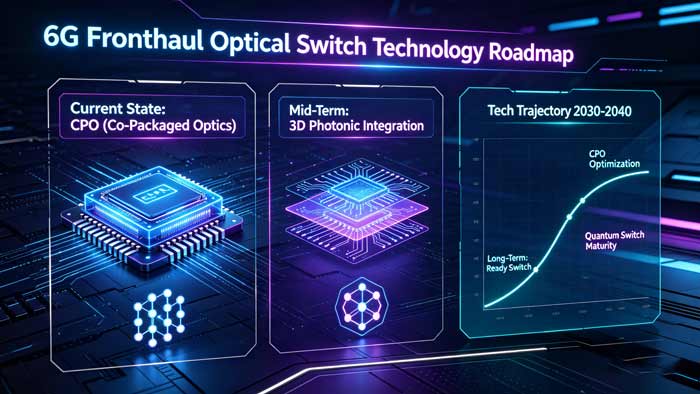
Next-generation optical switch technologies under development for 6G include:
• Three-dimensional photonic integration: Stacked switching layers for ultra-high density
• All-optical neural switching: In-switch AI for dynamic bandwidth optimization
• CPO (Co-Packaged Optics): Direct integration with fronthaul ASICs
• Quantum-compatible switches: Support for quantum key distribution over fronthaul
Based on global deployment experience, network operators should follow these best practices:
• Evaluate total cost of ownership: Consider CAPEX, OPEX, and lifecycle costs
• Match technology to use case: MEMS for reliability, silicon photonics for power efficiency
• Plan for scalability: Ensure architecture can evolve from 5G to 5G-Advanced and 6G
• Vendor diversification: Maintain multi-vendor environment for risk mitigation
• Conduct thorough site surveys: Identify environmental and power constraints early
• Plan fiber infrastructure: Ensure adequate fiber count and quality
• Establish SLAs with vendors: Define performance metrics and support requirements
• Train operations teams: Develop expertise in optical switch operation and maintenance
• Implement proactive monitoring: Deploy performance monitoring and alerting systems
• Establish maintenance procedures: Documented procedures for troubleshooting and repair
• Plan for obsolescence: Technology refresh cycles every 5-7 years
• Develop disaster recovery procedures: Ensure rapid restoration capability
The deployment of 5G-Advanced networks represents one of the most ambitious telecommunications infrastructure projects in history. Optical switching technology—at the heart of fronthaul architecture—provides the critical capabilities that enable these networks to deliver on their promise: massive bandwidth, ultra-low latency, and support for complex massive MIMO systems.
MEMS optical switches, with their proven reliability, low insertion loss, and mature manufacturing ecosystems, have become the dominant solution for 5G fronthaul core switching. Silicon photonics switches, while still maturing, offer compelling advantages in power efficiency and integration density—particularly for edge switching applications.
The economic benefits are clear: optical switches deliver 15-40% OPEX reduction and 10-12% TCO improvement over 5-year lifecycles compared to traditional electrical switches. These benefits have been validated in global deployments from South Korea, China, and the United States.
Looking forward, network operators deploying 5G-Advanced today must simultaneously plan for 6G's more demanding requirements. The optical switches deployed now must provide migration paths to 256×512 configurations, sub-10μs switching times, and integration with emerging CPO and quantum communication technologies.
Guangxi Coreray Optical Communication Technology Co., Ltd. (www.coreray.com) provides a comprehensive portfolio of optical switches specifically designed for 5G fronthaul applications. Their MEMS and silicon photonics solutions address the unique challenges of 5G networks while positioning operators for the future demands of 6G.
For telecommunications operators, the message is clear: optical switching is not just a component but a strategic enabler of 5G success. Organizations that invest in the right optical switching technology today will be positioned to deliver the performance, reliability, and scalability that 5G-Advanced and 6G networks require.
Optical switches are critical enabling components in 5G fronthaul networks, addressing bandwidth requirements 10-25× higher than 4G and ultra-low latency requirements for URLLC applications. MEMS optical switches dominate 5G fronthaul deployment with 64×128 configurations achieving <0.5dB insertion loss and >50dB isolation ratio. Silicon photonics switches offer 60-80% lower power consumption and CMOS compatibility for integration with base station electronics. Hybrid solutions combining both technologies optimize cost and performance. Economic analysis shows optical switches deliver 40% OPEX reduction and 12% TCO improvement over 5-year lifecycles compared to electrical switches. Global deployments by SK Telecom, China Mobile, and Verizon validate these benefits. Future 6G requirements project 100-200 Gbps bandwidth per base station, sub-100μs end-to-end latency, and 256×512 optical switch port densities. Emerging technologies including three-dimensional photonic integration, all-optical neural switching, and CPO integration will address these requirements.
2026-04-15
2026-04-13
2026-04-13


Scan to add on WeChat


 中文
中文 EN
EN